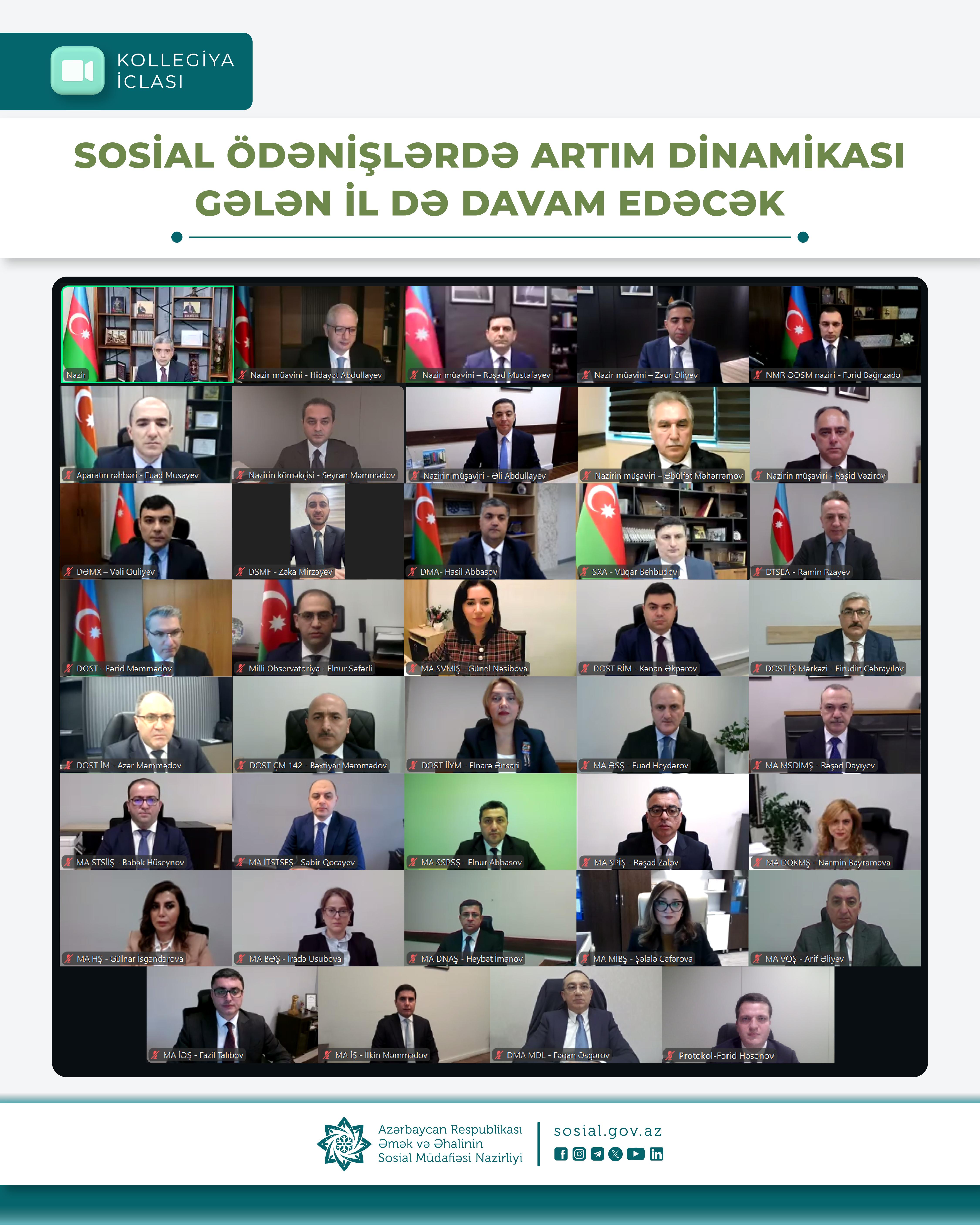
The Ministry held a Collegium meeting dedicated to the results of the first 10 months of this year and upcoming tasks.
The strong social policy pursued in our country has ensured the consistent implementation of reforms aimed at improving citizens’ well-being, while the reforms implemented have enabled significant increases in social payments. This upward trend will continue next year as well.
This was stated by Minister of Labour and Social Protection of Population Anar Aliyev at a Collegium meeting held at the Ministry dedicated to the results of the first 10 months of 2026.
It was emphasised that the development of the social protection system is one of the key priorities of President Ilham Aliyev’s policy. Over the past seven years, at the instruction of the head of state, five major social reform packages have been implemented, with an additional 8 billion AZN allocated annually. The minimum wage has increased 3.1-fold, the average monthly wage 2.2-fold, the wage fund 3.4-fold, the minimum and average monthly pensions 2.9-fold, annual funding for pension provision 2.3-fold, and annual funding for allowances and benefits 5-fold.
At the instruction of the President of the country, the next, sixth social package will be implemented next year, and the upward trend in social payments will continue in 2027. In particular, pensions covering 1.1 million people will be indexed and increased from the beginning of next year.
At the meeting, information was provided on the activities of the Ministry’s subordinate institutions during the first 10 months of this year. In particular, the monitoring, analysis, assessment and forecasting activities carried out by the National Observatory on Labour Market and Social Protection Issues, as well as the steps taken by the DOST Digital Innovations Centre to expand digital solutions in the state social services system and introduce artificial intelligence technologies, were highlighted.
The work carried out from January to October by the DOST Infrastructure Centre in the construction of new social facilities and implementation of infrastructure projects; by the DOST Centre for Inclusive Development and Creativity in developing the creative potential of vulnerable groups; by the DOST Work Centre in supporting the employment of socially vulnerable groups and their access to the labour market; and by the DOST Call Centre – 142 in promptly responding to citizens’ inquiries was also brought to attention.
It was noted that efforts to improve the social security system continued this year, and the process of implementing the foster family model was further simplified. Measures undertaken to fully digitalise the compulsory health insurance system, establish a unified electronic register of insured persons, automate the medical examination process and other areas were discussed. A number of amendments made to labour legislation this year, aimed at ensuring more reliable protection of social and labour rights, as well as new draft initiatives prepared in this area, were also highlighted.
The results achieved in these areas during the first 10 months of the year were analysed at the meeting, and upcoming tasks were discussed. The approval of new occupational and qualification standards was also considered, and an additional 294 standards were approved.