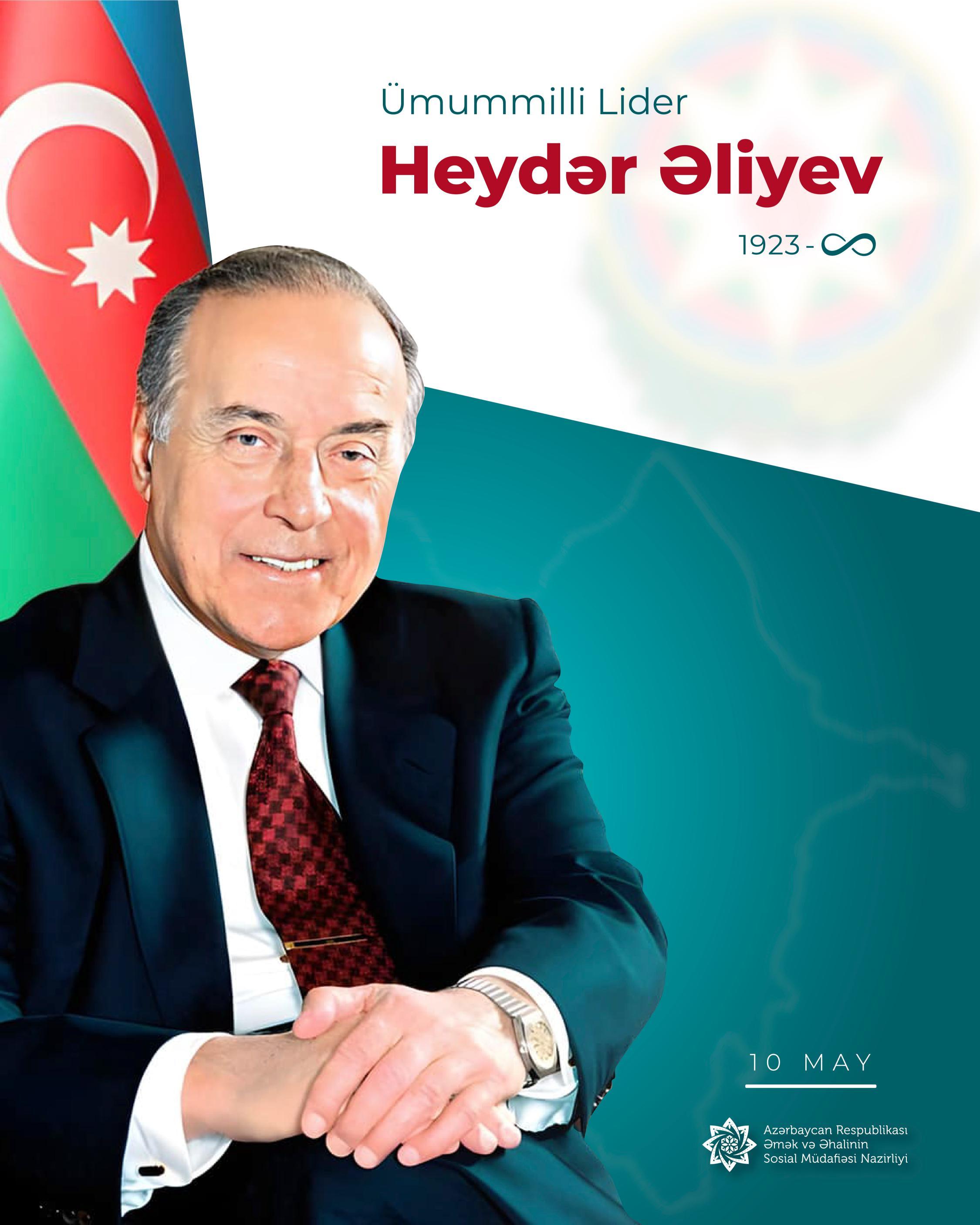





Today marks the 103rd anniversary of the birth of National Leader Heydar Aliyev.
National Leader Heydar Aliyev, who ensured the establishment of the modern independent Azerbaijani state and guided the country onto a path of long-term development, identified strengthening the social protection of the population and ensuring citizens’ welfare as one of the key priorities of state policy, thereby laying the foundations of a strong social policy in Azerbaijan. The first Constitution of independent Azerbaijan, authored by the National Leader and adopted through a nationwide referendum in 1995, also states that ensuring a decent standard of living for citizens of the Republic of Azerbaijan is one of the supreme objectives of the state.
Back in the 1970s and 1980s, National Leader Heydar Aliyev transformed Azerbaijan from one of the underdeveloped agrarian republics of the former Soviet Union into one of the leading republics. During that period, he consistently kept the social sphere and public welfare in focus and ensured significant progress in the country’s social development. Alongside economic growth, characterized by the establishment of major industrial sectors, hundreds of enterprises, and dynamic industrial expansion, the incomes and welfare levels of the population steadily increased. Important achievements were also made in training qualified specialists, building a highly skilled workforce, promoting employment among the able-bodied population, and ensuring the efficient use of labour resources.
In June 1993, returning to leadership at the insistence of the people, world-renowned political figure and distinguished statesman Heydar Aliyev rescued Azerbaijan from the dangerous processes, deep political, economic, and social crisis, and civil confrontation that threatened the country at the time, thereby ensuring the establishment and development of the modern independent Azerbaijani state. Defining the strengthening of social protection as one of the important tasks facing the state, National Leader Heydar Aliyev stated: “While applying the principles of the market economy and giving broad scope to a free economy, which we consider the main path, we must direct all these measures toward improving the welfare and social conditions of all segments of the population.”
As a result of the National Leader’s special attention to the social sphere, important steps were taken to strengthen the social security system and increase wages, pensions, and benefits. The coverage of social protection measures and social payments was significantly expanded. At the same time, a number of important new social programmes were launched, including housing provision for families of martyrs and persons disabled due to war, provision of automobiles to persons disabled due to war, improvement and expansion of rehabilitation infrastructure, establishment of new rehabilitation centres, and organisation of nationwide events aimed at promoting the talents and abilities of persons with disabilities.
Between 1993 and 2003, National Leader Heydar Aliyev signed more than 60 documents aimed at ensuring social development. During that period, the average monthly amount of pensions and benefits increased eightfold, while average monthly wages increased more than sixfold. Azerbaijan also became the first country in the CIS to adopt a new Labour Code and legislative acts related to social protection, employment, and labour migration that corresponded to the new socio-economic environment. In addition, the first State Programme on disability prevention and rehabilitation, the Pension Reform Concept, and the Demographic Development Concept were prepared and approved. Furthermore, in 1997, a state body responsible for supervising compliance with labour legislation — currently the State Labour Inspectorate Service — was established.
The wise and forward-looking policy of National Leader Heydar Aliyev is being successfully continued and further developed by President Ilham Aliyev. As a result, Azerbaijan today is one of the fastest-developing countries in the world, holding a worthy place in the international community, enjoying a prestigious position in the system of international relations, serving as a centre of power in the South Caucasus region, and rising to the peak of a glorious Victory. Alongside restoring its territorial integrity and state sovereignty, the country is also implementing a strong social policy.
“Our state is a social state. The centre of our policy is the Azerbaijani citizen — his concerns, his problems, his security, and his happiness,” stated the head of state. In line with the President’s instructions, five social reform packages covering 4 million people and amounting to an additional annual financial allocation of 8 billion manats have been implemented since 2018. As a result of these reforms, compared to 2018, the minimum pension has nearly tripled, the average monthly pension has increased 2.9 times, the average old-age pension has increased 2.7 times, annual allocations for benefits and stipends have increased fivefold, the minimum wage has increased 3.1 times, the average monthly salary has doubled, and the wage fund has increased 3.3 times. Over the past seven years, the share of social expenditures in the state budget has increased 2.2 times, rising from 7.8 billion manats to 17.1 billion manats. Expenditures on social protection and social security have also increased 2.2 times.
Alongside strengthening the social protection system, active employment programmes have been significantly expanded, and a modern, reliable, and sustainable social security system has been established.
One of the major achievements of social reforms carried out in recent years is the establishment of DOST centres. These centres have significantly improved the quality of social services. Under the DOST concept initiated by First Vice-President Mehriban Aliyeva, 162 social services are delivered to the population through a single platform and “one-stop-shop” mechanism in a transparent, efficient, and citizen-oriented manner.
Since the Presidential Decree of August 9, 2018, the DOST Agency, 7 DOST Centres, 2 DOST branches, and 3 DOST points have been launched in Baku and the regions. Public satisfaction with DOST services exceeding 98.8 percent once again confirms that the DOST model is a successful service model. Today, the DOST model has become a new national brand of Azerbaijan, gaining international recognition and being included among the world’s best practices, while countries such as Moldova, Uzbekistan, and Serbia have shown great interest in the DOST concept.
The housing programme for families of martyrs and persons disabled due to war is also being successfully continued. Following the 44-day Patriotic War, which ended with Azerbaijan’s glorious Victory, the programme was expanded fivefold. In the post-war period, the Ministry of Labour and Social Protection of Population has provided 7,200 apartments and private houses to families of martyrs and persons disabled due to war, bringing the total number to more than 16,000 over the years. In the post-war period, 567 automobiles were also provided to persons disabled due to war, bringing the total number to 7,700.
In recent years, the country’s rehabilitation system has also been modernised in line with contemporary requirements, and new rehabilitation facilities have been opened. Through the application of new rehabilitation methods based on advanced international experience, the range of services based on the biopsychosocial model has been significantly expanded. Important achievements have also been made in the extensive application of e-technologies in the field of state social services. More than 140 out of the Ministry’s 159 services — over 90 percent — have already been digitalised.
As a result of the strong social policy founded by National Leader Heydar Aliyev and successfully continued and developed by President Ilham Aliyev, Azerbaijan will continue to achieve new successes in ensuring citizens’ welfare in the years ahead.