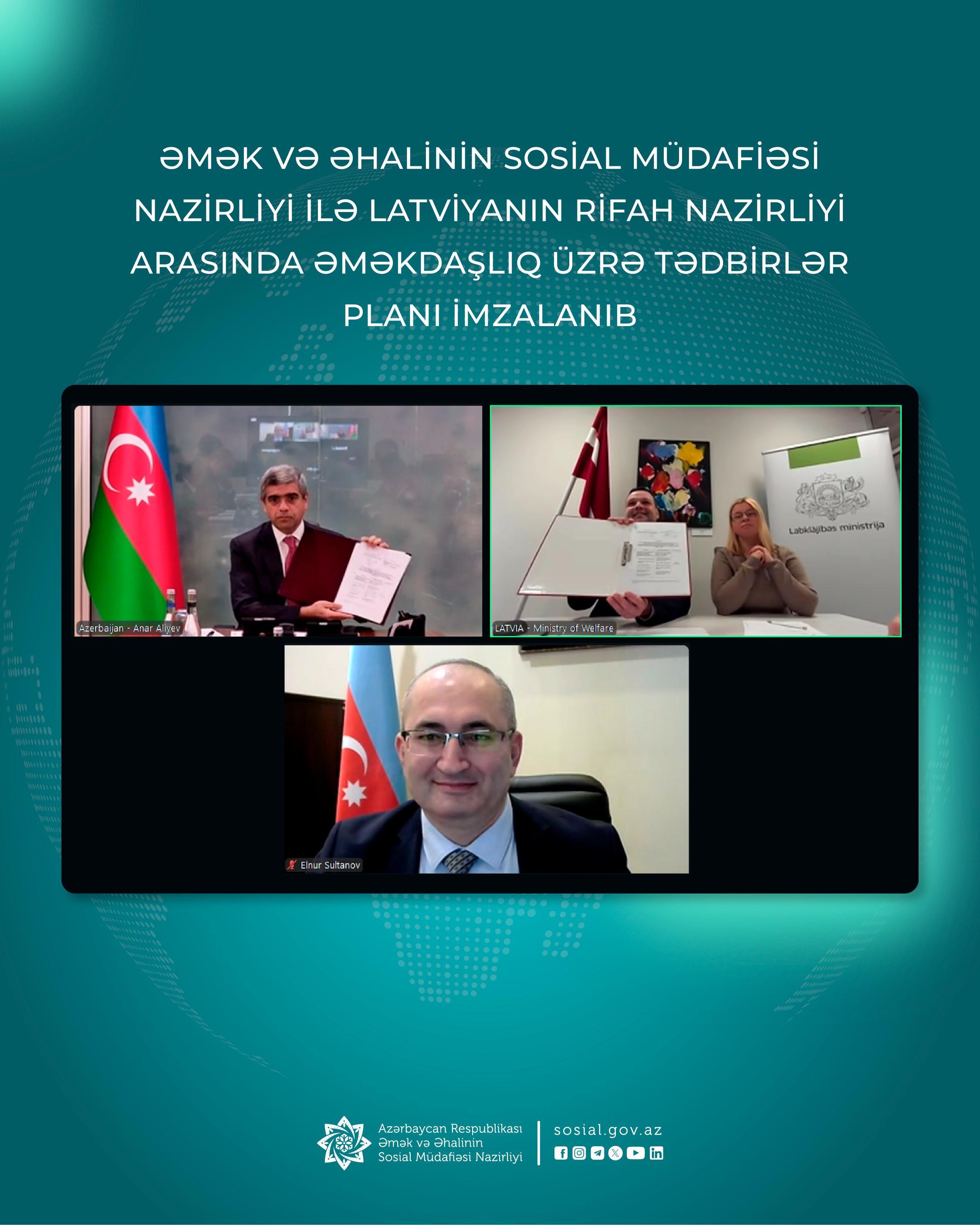





The high level of relations between Azerbaijan and Latvia has created broad opportunities for the continuous development of cooperation between the two countries in the fields of labour, employment, and social protection.
This was stated by the Minister of Labour and Social Protection of the Population, Anar Aliyev, during an online meeting with the Minister of Welfare of the Republic of Latvia, Reinis Uzulnieks. He provided information on the consistent social reforms carried out in recent years in Azerbaijan under the instructions of President Ilham Aliyev, as well as the steps taken to strengthen the social protection system and expand active employment programmes.
Attention was also drawn to the wider application of digital solutions in these areas and the strengthening of the process of training qualified personnel in accordance with the needs of the labour market. It was emphasised that special importance is attached to cooperation and the exchange of experience between Azerbaijan and Latvia in the mentioned fields.
Reinis Uzulnieks noted that they are interested in the continuous expansion of relations between the two institutions. He provided information about the social protection and employment programmes implemented in Latvia, as well as the country’s labour market. He also stated that purposeful efforts will continue in the coming period to successfully maintain bilateral cooperation.
Afterwards, Anar Aliyev and Reinis Uzulnieks signed the Action Plan for 2026–2027 on the implementation of the Memorandum of Understanding on cooperation between the Ministry of Labour and Social Protection of the Population of the Republic of Azerbaijan and the Ministry of Welfare of the Republic of Latvia in the fields of labour, employment, and social protection of the population.
The Action Plan envisages the exchange of knowledge and experience and the conduct of bilateral discussions on issues such as active labour market policy, employment of persons with disabilities and youth, monitoring and forecasting of the labour market, occupational safety, human resources management, digitalisation of services, development of the foster family care model, and the application of innovative solutions and artificial intelligence in the provision of social services.